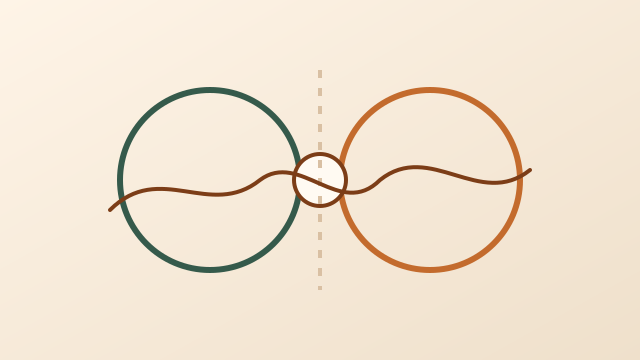
Every violinist eventually asks this question.
"Is my violin holding me back?"
"Would I sound better on a better instrument?"
"Is this just a technique issue?"
The uncomfortable truth: sometimes it is the player, sometimes it is the violin, and often it is both.
The good news is that there are reliable ways to tell the difference from sound alone, especially when recordings are standardized.
This article shows you how.
Why this question is so hard
Violins are unusual instruments because:
- the player is part of the sound-producing system
- small technique changes radically affect tone
- under-the-ear perception is misleading
A great player can:
- stabilize pitch
- minimize scratch
- compensate for uneven response
A weak instrument can:
- exaggerate noise
- resist clean attacks
- collapse at low bow pressure
When those overlap, people misdiagnose the problem.
First: what the violin controls (not the player)
Even with perfect technique, the violin determines:
1) Baseline noise floor
Some violins produce more:
- bow hiss
- surface noise
- grainy attacks
This is especially obvious on slow open strings.
Notice how one instrument sounds clean immediately, while the other fights the bow.
2) Response speed (how fast the sound speaks)
Good violins:
- respond quickly
- do not require pressure
- speak cleanly at low bow speed
Poorer instruments:
- hesitate
- crunch on the attack
- need force to wake up
This has nothing to do with intonation or vibrato.
3) Resonance balance across strings
Players often blame themselves for:
- weak G strings
- piercing E strings
- dead notes
Strong violins tend to be balanced, while weaker ones exaggerate extremes.
What the player controls (even on a bad violin)
1) Pitch stability
Even on open strings, poor bow control causes:
- pitch wobble
- unstable harmonic content
Pitch instability is almost always a technique issue.
2) Bow noise on fast attacks
Aggressive articulation can overwhelm any violin. If scratchiness only appears during fast passages or heavy bow pressure, it is probably the player, not the instrument.
3) Vibrato masking
Strong vibrato can:
- hide thin tone
- disguise uneven response
That is why sustained, non-vibrato notes are critical.
The single best test: slow, simple, unforgiving
If you want to separate violin from player, do this:
Record:
- open strings
- slow sustained notes
- slow scales
Use:
- minimal vibrato
- light to moderate bow pressure
Listen from a distance or recording.
Interpretation guide
Likely the violin
- sound collapses at low effort
- resists clean sound at low bow pressure
Likely technique
- pitch wobbles constantly
- scratch only on attacks
Strong instrument foundation
- tone stays stable and clean on simple notes
This is why our analyzer emphasizes open strings and sustained tones.
Why recordings reveal the truth
Under the ear, players hear:
- vibrations through the jaw
- bone conduction
- exaggerated high frequencies
Recordings remove that bias.
This is why blind listening tests consistently show:
- experts misidentify famous violins
- modern instruments competing with antiques
Key studies:
Why people often upgrade too early (or too late)
Too early:
- tone issues caused by bow control
- inconsistent intonation
- poor setup or old strings
Too late:
- violin resists clean sound
- student works harder for less result
- progress stalls despite good instruction
The key is evidence, not frustration.
How standardized analysis helps
Random clips are misleading. Standard inputs allow us to:
- compare similar bowing
- isolate instrument traits
- estimate how much is violin vs player
That is why our system outputs:
- an instrument tone score
- a technique and recording confound score
- confidence indicators
This avoids blaming the violin for technique or vice versa.
A simple rule of thumb
If the violin sounds bad when you play simply, but sounds fine when you work hard, the violin is probably the bottleneck.
If the violin sounds fine simply, but falls apart under complexity, it is probably technique.
The bottom line
You do not need to guess.
With slow notes, minimal effort, and honest recordings, you can usually tell whether your sound issues come from the instrument, the player, or both.
When you want an unbiased comparison, standardized audio analysis can show you where your violin ranks independent of labels, price, or reputation.
Want to find out which one it is?
Record the standard test and see:
- how your violin compares
- how much technique influences the result
- whether an upgrade would actually help